

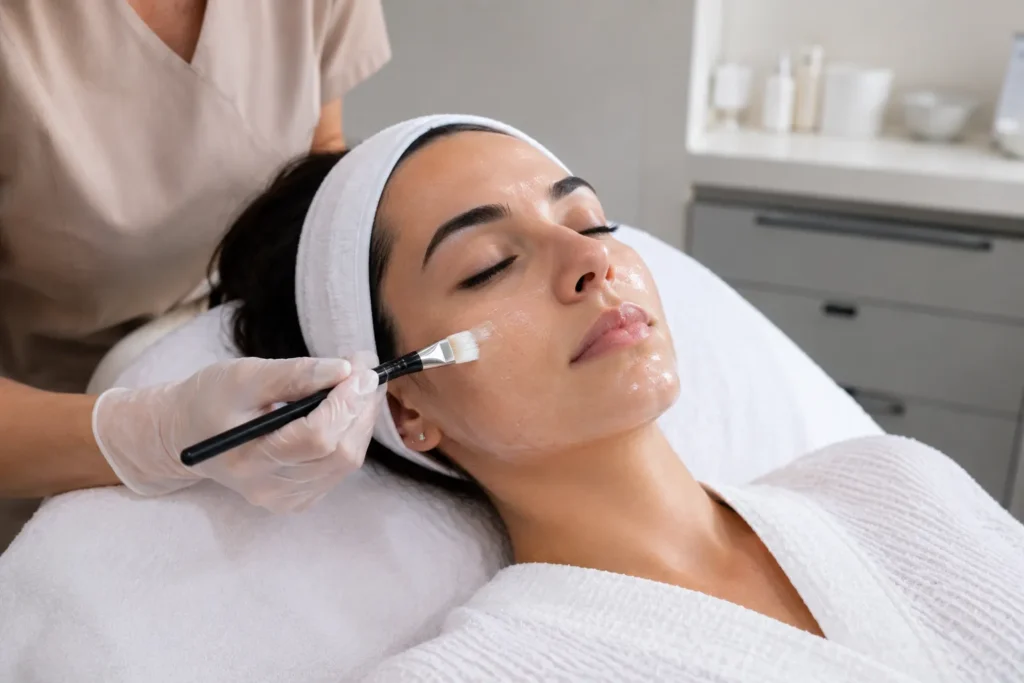
Does Your Face Peel After a HydraFacial? What to Expect
Short answer: usually not. A HydraFacial is designed to exfoliate without leaving you shedding for a week, and most people walk out looking fresher rather than raw. Some light flaking is possible for a small number of people, though, and knowing why it happens takes the worry out of it.
If you have booked one before a wedding, a work event or a weekend away, this is the detail you actually need.
Why it is not a peeling treatment
The confusion comes from the acid step. Partway through a HydraFacial, a mild solution, usually a blend of glycolic and salicylic acid, is applied to soften the oil and dead cells sitting in the pores. That word "acid" makes people think chemical peel, and chemical peels are the treatments that famously leave you flaking on day three.
The difference is strength and what happens next. In a peel, the solution stays on the skin long enough to loosen the top layer so it sheds over the following days. In hydradermabrasion, the solution is applied and immediately vacuumed away along with the debris it has lifted, then the skin is flooded with hydrating serum in the same pass. Nothing is left sitting on the surface to keep working. That is the whole reason people book this treatment for a Friday and go out on the Saturday.

When flaking does happen
A few situations make light shedding more likely, and none of them mean something has gone wrong.
The most common one is an add-on. Plenty of clinics offer a stronger booster peel alongside the standard treatment for congestion or thickened, oily skin, and that extra step can produce a day or two of flaking. If your therapist offers it, ask directly what the downtime looks like before you say yes.
Dehydrated skin is the second. If your barrier is already compromised from heating, air conditioning, over-cleansing or a long stretch of retinol use, exfoliation of any kind can tip it into visible dryness. In clinic we see this constantly through a Melbourne winter, when skin that felt fine in March starts flaking around the nose and mouth by July. It is worth mentioning your current skincare at the consultation rather than after the fact.
First-timers with a genuine build-up of dead skin sometimes notice a little shedding too, simply because there was more to remove than usual.
A realistic timeline
Straight after your appointment, expect your skin to look brighter and feel smooth. Mild pinkness is common and typically settles within a couple of hours.
Day one and two are usually uneventful. If any flaking is going to appear, this is when it shows, and it tends to be fine and patchy rather than sheet-like, concentrated around the nostrils, chin and anywhere already dry. Day three onwards it resolves on its own.
Some people notice a few small blemishes appearing in the first week. That is generally congestion that was already sitting below the surface coming up after extraction. It settles, and it is one of the reasons a series of treatments works better than a single session before an event.
What to do if your skin flakes
Do not pick, scrub or help it along. Peeling skin that is still partly attached is protecting what is underneath, and pulling at it is how people end up with marks that outlast the flaking by weeks.
Keep the routine boring for a few days:
Leave out retinol, AHAs, BHAs, vitamin C, scrubs and cleansing brushes for at least 48 to 72 hours, then reintroduce them one at a time rather than all at once.

Skip the sauna, hot yoga and long hot showers for a day, and hold off on waxing, threading or any other resurfacing treatment for a couple of weeks. Doubling up on exfoliation is where most post-treatment irritation actually comes from.
Sun protection matters more than usual in the days afterwards, since freshly exfoliated skin pigments more readily. Australian UV is unforgiving even on overcast days, and pigmentation is far easier to prevent than to correct.
When flaking is worth a phone call
Light dryness for two or three days is normal. The following are not, and your clinic should hear about them:
The same goes for repeat flaking after every session. If your skin sheds each time, the treatment is likely too aggressive for your barrier and the protocol should be adjusted or spaced further apart. A therapist who knows your skin will change the plan rather than tell you to push through it, which is why continuity with one clinic tends to produce better results than treatment-hopping.
Choosing the right treatment for your skin
Hydradermabrasion suits congested, dull or dehydrated skin beautifully. If your concerns run deeper, into pigment, laxity or persistent breakouts, a resurfacing facial on its own will not get you there, and a properly built plan will serve you better. Our team assesses your barrier and hydration levels before recommending any of our professional skin treatments in Richmond, because the same treatment behaves very differently on compromised skin than it does on healthy skin.

That assessment is also where we work out timing. Booking anything exfoliating three days before a big event is a gamble worth avoiding, and there is almost always a better window.
Flaked after a facial before? Book a skin consultation in Richmond.
Talk it through first
If you are unsure whether your skin will handle exfoliation comfortably, or you have flaked after a facial before and want to know why, come and have a proper look at it with us. Our diagnostic skin scan shows hydration and barrier condition below the surface, which is usually what settles the question.
Get in touch with our Richmond team to book a consultation. It is complimentary when booked alongside a skin treatment, and it is the simplest way to avoid surprises.
